 |
 |
 |
|
|
|
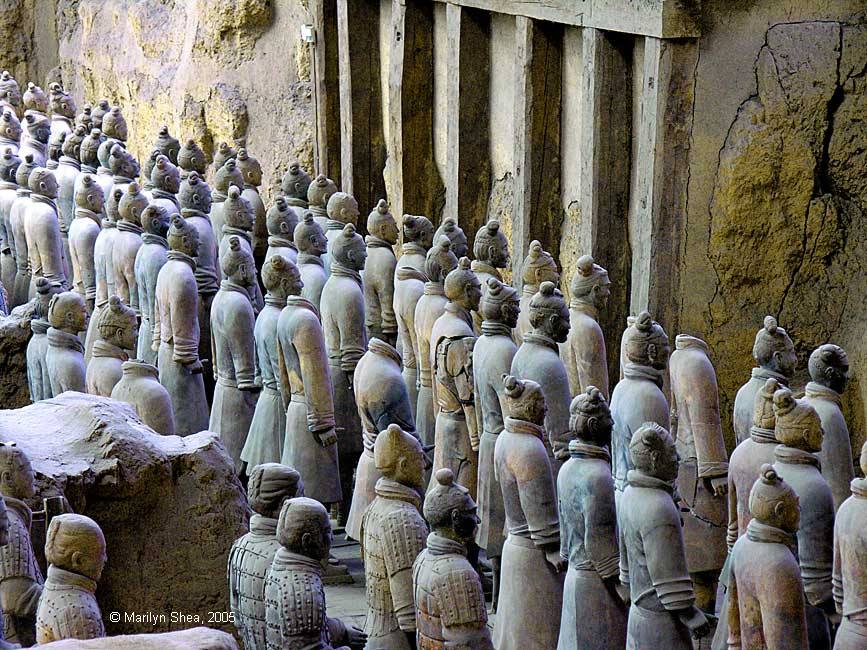 |
| When the warriors were first excavated they bore traces of colors. Only about 1,000 of the warriors are on view. The remaining sections have been left covered to preserve them. As new sections are opened, the scientists want to preserve the colors. There is constant on-going research to determine the effects of air, moisture, insects, pollutants, and preservation materials on the warriors and related artefacts.
Recent chemical analysis has shown that the paints used egg as their binding property with various minerals and plant materials to make the color (Bonaduce, Blaensdorf, Dietemann, Colombini, 2008). Identification of the binder will help recreate the processes that produced the colors in the first place and perhaps help preserve them. In 2004, a warrior with a green face, black eyebrows, and fiery eyes went on exhibition in Beijing (China Daily October 19, 2004). The warrior was one of the first to be preserved with a new technique developed by Heinz Langhals and Daniela Bathelt (2003), The technique involves flooding the terracotta material moments after it is exposed to the air in a series of steps culminating in the application of what is the essential ingredient in super glue. The polymer fixes the pigments and prevents their exposure to air and changes in moisture content. Before this technique was developed, the warriors lost their colors quickly when unearthed. The moisture in the earth was maintaining the pigments, although they were faded. When exposed to dry air the paint simply dried up and flaked off. Thanks to their work, archaeologists are faced with other new puzzles. Why a green face? They speculate that it could indicate that the warrior was from another non-Han tribe or that , as is common in many cultures, the face was painted to look more ferocious to the enemy. It may have something to do with funeral rites and scaring away demons. At this point, there is little more than the green face as evidence so you can come up with your own hypothesis. The preservation technique also allowed the preservation of a warrior wearing purple pants, or I suppose they should be called leggings. The color purple fascinates archaeologists because it so often is coupled with royal cultures around the world. The same is true in China. The heavenly seat of power is called the Purple Heavenly Palace. It is there that the emperor goes after death and it is from there that he or she derives power. Samir Patel summarized recent findings concerning the color purple for Archaeology in 2007. In 1992, Elisabeth FitzHugh identified barium copper silicate as the main component of Chinese purple. Heinz Berke, a chemist at the University of Zurich, analyzed some of the purple from the warriors and found it to be highly similar to that used by Egyptians of the same period. The compounds differ, but the color is about the same. Berke does not think this was due to a cultural exchange of chemical knowledge. Another hypothesis for the source of Chinese purple comes from Bob Brill of Corning Glass. The barium found by FitzHugh in the purple paint is also a component of Chinese glass made during the period. Once a chemical is identified and used in one application in a culture, it is likely that it would be tried in all sorts of other situations. Patel recounted the theory proposed by Zhi Liu who got interested in the problem and analyzed paint chips at the Linear Accelerator Center and Lawrence-Berkeley National Lab in California. Zhi's hypothesis is that Taoist monks were playing around with barium to make imitation white jade and happened upon the color purple. The Daoists were noted alchemists who worked to find ways of extending life and improving health. He further speculates that the particular color purple disappeared from view when Daoism when into a decline. That theory requires the assumption that the Daoists were the only ones who knew the recipe. It is just as likely that the color went out of fashion or was supplanted by an easier process. Both Brill and Burke disagree with Zhi Liu's theory. Burke sees the change to be one of political and economic factors rather than religious change. Considering Burke's point it is logical that if an emperor wanted that particular color purple and the Daoists had it, he would have gotten it. There are many more colors to be investigated. Perhaps they will give some clue as to the changes in pottery making and painting that took place over the next three to four hundred years.
Bonaduce, Blaensdorf, Dietemann, Colombini. "The binding media of the polychromy of Qin Shihuang's Terracotta Army." Journal of Cultural Heritage, 2008, Vol. 9 Issue 1, pp. 103-108. Langhals, Heinz; Bathelt, Daniela. "The Restoration of the Largest Archaeological Discovery - a Chemical Problem: Conservation of the Polychromy of the Chinese Terracotta Army in Lintong." Angewandte Chemie International Edition. December 1, 2003. Vol. 42, 46, pp. 5676-5681. Patel, Samir S. "Purple Reign." Archaeology, Sep/Oct 2007, Vol. 60, 5, pp. 25-27. |
http://hua.umf.maine.edu/China/xian2.html
Last
update: March 2010
© Marilyn Shea, 2010