 |
 |
 |
|
|
|
 |
|
The city walls of Xi'an were built between 1374 and 1378. The city was much smaller than it had been during its heyday in the Tang Dynasty. The Ming Dynasty was founded by Zhu Yuanzhang 朱元璋 (Zhū Yuánzhāng, 1328 - 1398) a commoner who managed to overthrow the Yuan Dynasty. He didn't set out to be an emperor. As a young man he traveled and saw the conditions of China. He stayed at a Buddhist monastery to learn to read and write and learn about the world. While he was there Ming troops burnt it down. Shortly afterwards, in 1352, he joined a rebel group and rose quickly to successive leadership positions. Soon he was the head of the army and then sitting in a newly conquered Nanjing with most of southern China under his rule. He was fortunate in the advisors he chose. One of them, Zhu Sheng 朱升 (Zhū Shēng), is credited with giving this advice to Zhu Yuanzhang: "Build high walls, stock up rations, and don't be too quick to call yourself a king." He did just that. He sat in Nanjing consolidating his power and defenses, waiting until he had sufficient power to defeat the Yuan in its stronghold in the north.
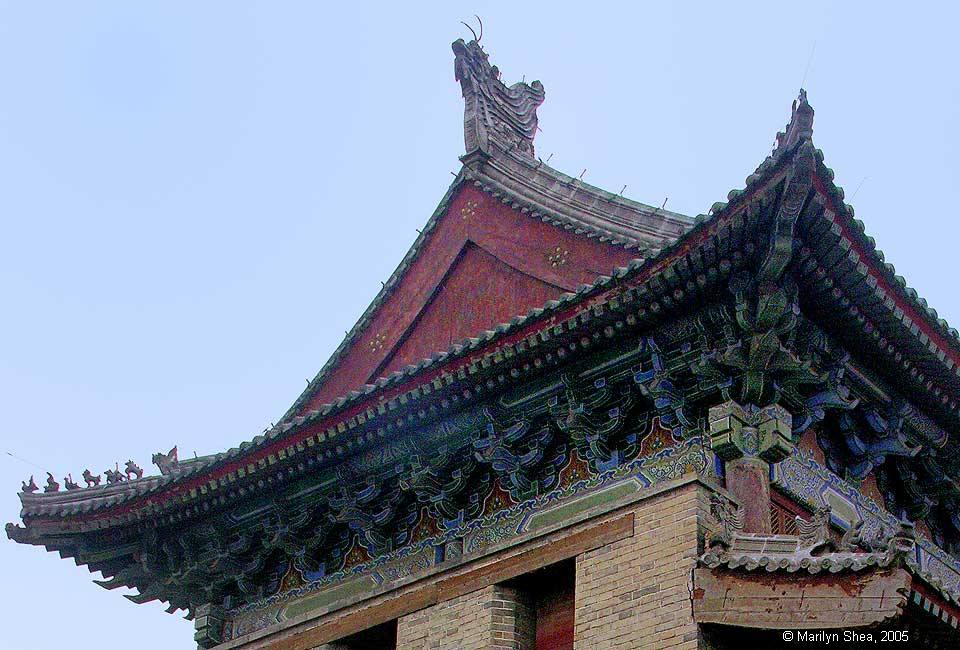
In 1368, he declared the Ming Dynasty and took the name Hongwu 洪武 (Hóng Wǔ). Emperor Hongwu ordered that walls be built in Xi'an because of its strategic position. The city walls are built with pounded clay in successive layers. The foundation is rammed earth with lime, clay, and sticky rice to provide a solid base. The city isn't quite square. The east wall is 1.6 miles long, the west wall is 1.635 miles long, the north wall is 2.016 miles long, and the southern one is 2.138 miles long. The wall is 7.39 miles or 11.9 kilometers long and encloses 4.63 square miles of land. They are 39 feet high, 49 to 59 feet wide at the base, and 39 to 45 feet at the top. The top of the wall is wide enough for soldiers to ride horseback from one section to another or for large carts to bring munitions and supplies to defenders. Almost 6000 battlements provide ample opportunity to shoot arrows, or later, to mount cannon. There are four gates, each has a protective enclosure jutting out to protect the entrance. The enclosures measure 40 feet wide and 40 feet deep and an Archery Tower stands guard on the outside of each. A second tower stands opposite to the Archery Tower and is the city gate. In addition, a rampart was built every 400 feet, jutting out from the main wall. This gives good coverage all along the wall and traps enemy forces in a cross-fire. |
http://hua.umf.maine.edu/China/xian2.html
Last
update: March 2010
© Marilyn Shea, 2010