 |
 |
 |
|
|
|
 |
| The third thing that he did was to build roads. This may sound anti-climatic after the Great Wall, but the roads did more toward the eventual unification of China than did the Wall. By building well maintained and drained roads that ignored the previous boundaries and frontiers of the old States, he was able to unite their markets, open new territory, and make the defense of the populace easier. Good roads also aid invasion forces, but that is something you just have to deal with when the time comes. Under the old State system during the Warring States Period, populations gathered around the capitals of the States and avoided the edges of territorial borders because of the number of attacks and raids that were made by neighboring States. It just wasn't a safe place to live. With the new Qin plan, those areas could be served by good roads and freed of the fear of attack. They were one country with one ruler.
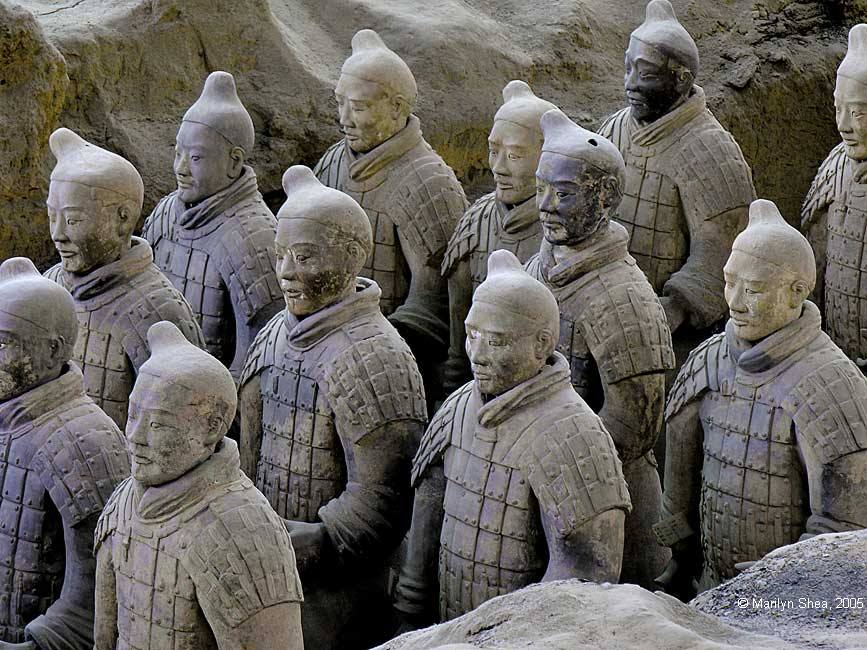
The inclusion of warriors of different cultures and ethnic backgrounds in the terracotta army may have been a message to the people of this new reality. Or it may just have been reality and the designers didn't consider the political message at all. It is most probable that Qin Shi Huangdi was aware of the symbolic nature of the projects within the capitals. This was a man who saw his destiny as the First Emperor. He wasn't shy about it. He not only planned the biggest mausoleum possible, but also planned an enormous palace complex called Efang. To be the Choice of Heaven you had to have the trappings to take the place of the early Zhou rulers. To further unite the country, he abolished the old royalty system used by the Zhou and centralized government. Instead of depending on local kings to rule their areas and contribute soldiers and taxes to the central government, he established administrative districts and appointed administrators who could read and write. They would be responsible to and report to the central administration and their appointments would not be hereditary. The appointments were to be based on merit and to avoid the corruption that plagued the old system, administrators would be rotated regularly. While these achievements are counted on the plus side of Qin Dynasty, later generations trying to understand the downfall of the Qin, counted them as minuses because of the costs in both material and manpower. They pointed in particular at the Efang Palace and the Mausoleum to emphasize excess and cruel tyrannical use of labor. When you add up the estimates of all the labor involved it numbers in the millions, well beyong the ability of the population at the time to support. |
http://hua.umf.maine.edu/China/xian2.html
Last
update: March 2010
© Marilyn Shea, 2010