 |
 |
 |
|
|
|
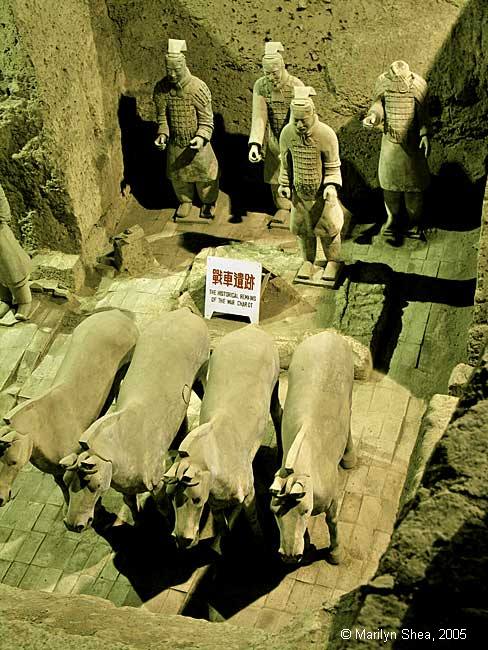 |
| The sign says "Historical Remains of the War Chariot" indicating that this is the location of the single chariot found in the chamber.
Citing evidence from Stuart Pigegott, Shaughnessy (1988) said that the chariot entered China from the northwest regions in about 1200 BC. Shaughnessy makes a good case for a three stage introduction of the chariot to the culture. During the Shang Dynasty it was primarily a status symbol and limited in its use. The Zhou warriors used chariots as well, but it is just as likely that they also received the technology from the northwest as that they got it from the Shang. From roughly 1200 to 800 BC the chariots bore strong resemblance to one another, with small variations in size, number of spokes, and the materials with which they are made. Shaughnessy hypothesizes that one reason the Zhou were able to conquer the Shang Dynasty was because the Zhou warriors used chariots. During the Zhou Dynasty the chariot spread widely and there are many accounts of large numbers of chariots captured in battle. This is the second stage of integration into the culture. We learn from inscriptions on bronze vessels that Zhou kings were in the habit of presenting fittings for horse livery and chariots to new appointees, military commanders, and people they wanted to honor. The fittings would set the individula apart as insignia of office and signs of the favor of the emperor. Others would have chariots, but not with royal fittings. The chariot is not suited to all turrains. It's good on a nice flat plain, but useless in a swamp or in the mountains. By the Warring States Period of the Eastern Zhou Dynasty the chariot had been relegated to a minor role in the military and the mounted rider had come to the fore as a weapon of war. It is interesting that there has been only one saddled horse found in the four pits. When the excavation is expanded a cavalry might be discovered, but that will have to wait. The small number of chariots included in the formations tend to support Shaughnessy's thesis that the chariot was in the third stage of use. The two bronze chariots found near the mausoleum of Qin Emperor Shihuang are pictured in the section on the Terracotta Warriors and Horses Museum which is the next section in the index. The Chinese chariot was usually open, held three warriors, and were about 1 meter deep and up to 1.5 meters wide. They had two wheels with 18 to 24 spokes place on a center axle. There was a single center pole from the chariot to the horses. At so,e point the horses began to be outfitted with armor to protect them from arrows. The armor could be over-lapping metal plates or plates of specially treated leather. Shaughnessy, Arthur L. "Historical perspectives on the introduction of the chariot into China." Harvard Journal of Asiatic Studies. (June 1988), Vol. 48. 1, pp. 189 - 237. |
http://hua.umf.maine.edu/China/xian2.html
Last
update: March 2010
© Marilyn Shea, 2010